

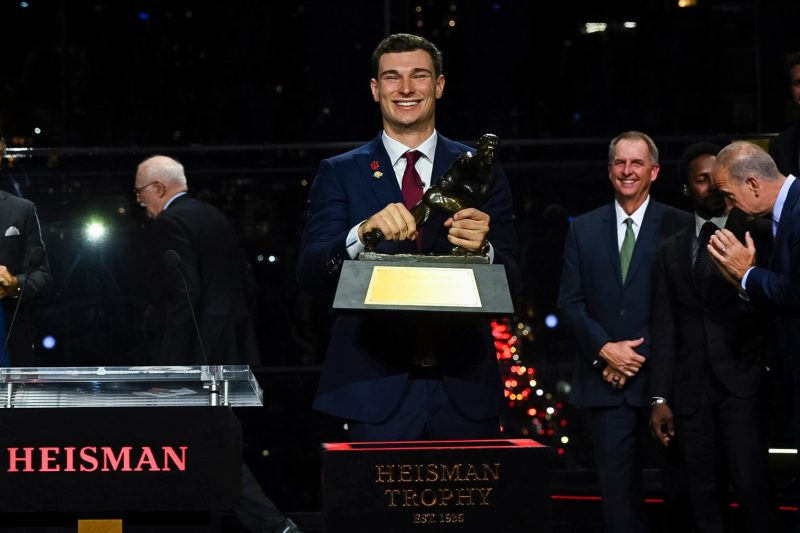
- Quarterback Fernando Mendoza led Indiana University to an undefeated season and won the 2025 Heisman Trophy.
- Mendoza, once an overlooked high school recruit, credits his success to his Cuban-American heritage and work ethic.
- Mendoza is the first Cuban-American to win the Heisman and is projected to be a top NFL draft pick.
MIAMI ― Fernando Mendoza sat in the front seat of the rental car on the six-hour drive from Miami to Gainesville, dialing one college coach after another.
He had just finished a week-long visit to some of college football’s most elite programs in the Southeastern Conference – Alabama, Clemson, South Carolina, LSU – and Mendoza, then a high school junior quarterback, needed to convince them to put him on their roster.
One after another, he called and asked the coaches if he could play for them. One after another, their answer was an unequivocal “no.”
He ended each call with the corresponding cheer from that team – “Go Tigers!”, “Roll Tide!” – characteristically upbeat, despite the rejections.
After checking into a Gainesville hotel with his speed and conditioning coach, Antonio Robinson, Mendoza confided something that had been weighing on him. His mother had recently confessed she’d long been diagnosed with multiple sclerosis, an incurable disease of the nervous system. He had to win, he told him, for her.
“Bro, you’re good. You’re going to play on Sundays,” Robinson told Mendoza at the time, meaning playing in the NFL. “We don’t know how you’re going to get there, but you’re going to play.”
Today, Mendoza, 22, sits atop of the college football universe.
As Indiana University’s starting quarterback, he led the Hoosiers this year to an historic undefeated season and secured the top ranking in the College Football Playoffs, which began Dec. 19. Indiana plays the dynastic University of Alabama in the Rose Bowl on Jan. 1 for a chance to advance and play for the national title – which would be another first for Indiana, traditionally a basketball-first school.
On Dec. 13, Mendoza was also awarded the Heisman Trophy, college football’s highest honor, becoming both the first Hoosier and first Cuban-American to ever win the award – and only the third Latino winner after Jim Plunkett in 1970 and Alabama’s Bryce Young in 2021.
Several mock drafts, including USA TODAY’s, forecast Mendoza – ranked 2,149th in the nation coming out of high school – as the No. 1 selection in next year’s NFL draft.
How did a lanky, six-foot-five kid from Miami – the grandson of Cuban immigrants and overlooked by most football schools – rise to such improbable heights in college football?
Mendoza’s coming of age in Miami would be marked by a cultural changing of the guard, when tackle football was becoming increasingly popular among Cuban-Americans, who have traditionally focused on baseball.
His Cuban heritage sparked a work ethic that often eclipsed others around him. And even as obstacles piled up, Mendoza found a way to work around, over or straight through them.
In recent interviews, Mendoza has credited his Cuban-American culture and upbringing for much of his success.
“It’s a huge point of pride,” he told NBC Sports, adding how his grandparents emigrated from Cuba to start lives over in the U.S. “I’m extremely grateful for all the hardship they’ve been through.”
First quarter: The shift to focus on football
Baseball-Reference.com counts more than 400 Cuban-born players who have played in the major leagues, dating back to 1871, when Havana-born Esteban “Steve” Bellán laced up for the Troy Haymakers. Total Cuban-born players to ever play in the NFL: four.
“Porque en Cuba…” “Because in Cuba” was a common line of reasoning and refrain of many parents to urge kids in 1980s Miami to spend hours on end at the batting cages. Boys spent their Saturdays at Tamiami Park or Academia Carlos “Patato” Pascual, learning fundamentals like rundowns or how to lay down a bunt at the hands of retired Cuban ball players, dreaming of one day playing in the majors themselves.
Florida, of course, has long been a perennial powerhouse for recruiting high school football talent.
It’s one of the nation’s top destinations for elite college football since the 1990s, during which a team from the state appeared in every national title game until 2002. Florida’s juggernaut status continued well into the 2000s. According to the recruiting database ESPN 300, Florida produced the most prospects of any state in the country in the class of 2023. Lamar Jackson, Michael Irvin and Joey and Nick Bosa are counted among South Florida’s high-end recruits.
But the past two decades has seen a noticeable shift in Cubans and Cuban-Americans in South Florida becoming focused on football, said Carlos Gobel, 47, a high school football coach who has coached youth sports for more than 20 years in South Florida.
Would-be pitchers made the switch to quarterbacks. Spurred on by the past successes of the Miami Dolphins’ perfect 1972 season and their Hall of Fame quarterback Dan Marino, Gen Xers took to playing football in high school.
By the time these Cuban families in South Florida became parents themselves, they placed their kids into rec leagues, starting as young as 4 years old, Gobel said. Youth leagues today, like Miami Xtreme or Florida Youth Football League, actively try to recruit the best young talent and parents are hiring specialized coaches to train their youth earlier and earlier, he said.
He added: “Everyone loves football down here. Fernando came in right at its peak.”
Second quarter: ‘He’s just built different’
Mendoza was destined to play organized sports.
His father, Fernando Mendoza IV, played football at Christopher Columbus High School in Miami (alongside Mario Cristobal, current head coach at the University of Miami), and later as an undergraduate student at Brown University. His mother, Elsa Mendoza, was a standout tennis player at the University of Miami.
He joined the South Miami Grey Ghosts, part of a local youth league, while in grade school but started as a fourth string quarterback, according to an essay his mother published in The Players’ Tribune, an online platform. Mendoza had to work his way into a starting position.
By the time he reached 8th grade, Mendoza’s sights were firmly set on playing quarterback in college. That year, his father hired Robinson to improve Fernando’s speed and agility.
In one of their early meetings, at Florida Christian School’s West Campus, Robinson had him and other student athletes do 15 100-meter dashes, back-to-back-to-back, with just 30-second breathers between runs.
It’s the type of grueling conditioning, especially in Miami’s punishing sun, that makes most youth puke or beg for a break, Robinson said.
Mendoza caught his breath then asked: “We got anything else?”
Robinson, a former NFL receiver who won a Super Bowl ring with the Green Bay Packers in 2011, put him through more workouts.
“He’s just built different,” Robinson said. “I remember telling my son, ‘This kid’s going to play in the NFL.’”
Robinson worked with Mendoza the next four years, meeting with him several times a week, having him pull weights in a dead run or running backwards up hills at parks, watching his acceleration and agility improve.
In 10th grade, Mendoza began playing football at Columbus High School, his father’s alma mater, located in the heart of Westchester.
Calle Ocho (or, Eighth Street) remains the beating heart of the Cuban diaspora in Miami but Westchester (pronounced “Weh-che-te” in the truncated lingo of Cuban-Americans) is its gravitational center, home to La Carreta, Rio Cristal, Sergio’s and other establishments and eateries that, over the years, have transformed the sleepy Miami suburb into North Cuba.
At Columbus, Cuban-American parents aspire to raise their boys in the teachings and values of the Catholic Marist Brothers families once followed in Cuba.
Mendoza came to play under Coach Dave Dunn, who has coached high school and collegiate athletes for three-and-a-half decades. At their first meeting, Mendoza showed up with a notebook and a pen, eager to soak up everything his coach had to offer, Dunn said.
Over the next three years, Dunn and Mendoza lunched together each day in Dunn’s office, meticulously going over practice film, discussing his mistakes or strategizing plays for the upcoming game.
“He’s always trying to learn, always working his tail off to get better,” Dunn said. “And I think that’s ingrained in him from his grandparents and obviously his parents, as well.”
Halftime: A transformative trip to Cuba
All four of Mendoza’s grandparents fled Cuba’s dictatorship and emigrated to the U.S. to seek a better life.
His paternal grandmother, Marta Menocal Mendoza, arrived in the U.S. via Operation Pedro Pan, a clandestine exodus of more than 14,000 unaccompanied Cuban youth from the communist island.
His maternal grandfather, Alberto Espino, arrived in Miami as a teen in 1960 from Santiago de Cuba. In 2019, Mendoza and his younger brother, Alberto, joined their grandparents on a missionary trip to Santiago de Cuba on the easternmost part of the Caribbean island.
They climbed along the Sierra Maestra mountain range, home to Fidel Castro’s 1950s uprising, visited the chapel of La Virgen de la Caridad del Cobre, Cuba’s patron saint, and distributed goods they brought from the U.S. to cousins and locals in Santiago.
Mendoza was struck by how his impoverished family members survived while having next to nothing. It was a transformative trip, as he later expressed in an essay in an application to the prestigious Miami Herald’s Silver Knight Award in high school. Amazon founder Jeff Bezos and U.S. Supreme Court Justice Ketanji Brown Jackson are among its past winners.
“I had arrived in Cuba with no expectations but left with a sense of place in this world,” Mendoza wrote, “Whatever I accomplish or fulfill in my lifetime, I will always represent my cousins, family, and community back in Santiago.”
At Columbus High, a Catholic, all-boys school, Mendoza was as focused on the classroom as he was on offensive schemes, said Sylvie Galvez-Cuesta, his guidance counselor. He loaded up on the most challenging math and science classes, was director of the campus ministry and helped launch a student-led podcast.
In 2022, after escorting the 15 Silver Knight nominees to the Miami Herald offices for interviews, Galvez-Cuesta took the students to lunch at a restaurant in South Miami.
Midway through the meal, Mendoza tapped his water glass with a fork, stood and gave an impromptu speech thanking the faculty on behalf of the students. The counselors there were in tears.
“That’s Fernando in a nutshell,” Galvez-Cuesta said. “That will always stay in my heart: how heartfelt this young man was at 18 years old.”
Third quarter: Pre-dawn workouts, broken fingers
Jose Leon began at Columbus High School as a freshman wide receiver, as Mendoza entered his junior year as the team’s starting quarterback. Prodded by his dad, Leon sent Mendoza an Instagram message, offering to work out with him.
As a freshman, Leon thought the chances of the school’s varsity quarterback replying were slim. To his surprise, Mendoza responded immediately, suggesting they meet early to catch passes.
For the next five months, the two met at 5 a.m., three days a week, at the Columbus practice field, before the 5:45 a.m. practice with the rest of the team, to have Leon run routes and catch passes from Mendoza.
Leon broke three fingers fielding passes from Mendoza’s increasingly powerful arm. But the pre-dawn sessions forged a bond between the two.
Leon would later visit the Mendoza Coral Gables home to play Madden NFL video football games with Mendoza and his younger brother, Alberto, shoot hoops in the backyard or have breakfast with them at La Carreta, a Cuban culinary landmark, where they munched on Cuban toast and croquetas.
Often, right after meals, Mendoza would dart back home to study or meet with his parents, Leon said.
“He was locked in,” said Leon, now on the football squad at Appalachian State University in North Carolina. “I can’t recall a time I’ve ever seen him at a party.”
Fourth quarter: A life-altering diagnosis
In 2020, his junior year, Mendoza took the reins of the Columbus High School football team.
As the coronavirus continued spreading across the U.S., he led the team to an undefeated season, but statewide competitions were cancelled due to the outbreak. Instead, the team won a tri-county championship that included Miami-Dade, Broward and Palm Beach counties.
Following closely in his footsteps was his younger brother, Alberto Mendoza, who later led the Explorers to back-to-back state championships and broke the school record for most passing yards (2,611) and passing touchdowns (35) in a season. He’s currently backup quarterback at Indiana behind Mendoza, foreshadowing a Manning family-like takeover of the sport in the coming years – with a mojo criollo twist.
“If you ask anyone around campus, [Alberto] is the best quarterback to ever play at Columbus,” said Andres Fernandez, their high school quarterback coach. “He is absolutely special.”
At Indiana, the brothers share a house together and Alberto closely follows Mendoza’s game day preparation and decision-making. The brothers each threw for a touchdown in a win over Kennesaw State on Sept. 6, marking the first time brothers on the same team have thrown a TD pass in one game since Brandon Allen and Austin Allen did it for Arkansas in 2015.
“Being able to play with each other, not a lot of people get to share a locker room or a meeting room, let alone a house with their brother in college.” Fernando Mendoza said in an interview with IndyStar, part of the USA TODAY Network. “I’ve learned a lot of tricks from Alberto.”
Their bond started at an early age, when their mother had them share a room, even though their house had a spare room, to get them to grow closer, Mendoza told IndyStar.
Then, midway through high school, the Mendoza brothers received one of the most crushing news of their lives: Mom had multiple sclerosis.
Elsa Mendoza had known for years that she carried the disease but kept it from her sons, hoping not to cause them undue worry. After contracting COVID, however, she became so weak that she could no longer hide it from them.
“It was during football season, and I realized I wasn’t going to be able to travel,” she wrote in her Players’ Tribune essay. “And the thought of you wondering if I supported you any less, because suddenly I wasn’t at your games? I hated that. So that’s when I knew we had to sit you and your brother down … No amount of years could have prepared me for how hard of a conversation it ended up being.”
Elsa Mendoza described how her firstborn son kept her company early in life, while his dad worked long hours on his path to becoming a doctor. “Maybe this is silly to say about a newborn,” she wrote, “but to me you were more like my buddy.”
Mendoza took the news as best as could be expected, Elsa Mendoza wrote, filling her with confidence and helping to raise awareness about MS.
“[You’ve] made it so much easier,” she said. “And you’ve done that in the sweetest, strongest, most Fernando way possible — by making me feel the exact opposite of embarrassed. You’ve made me feel seen.”
Two-minute warning: No offers, then California-bound
Generally unnoticed because his breakout year was during COVID, Mendoza didn’t receive any calls from elite football teams.
After his road trip through the Southeast with Robinson netted no scholarships, Dunn, his coach, reached out to more than 50 contacts he knew in college football programs, asking if anyone needed a quarterback. Not a single one was interested.
“I called everybody I knew and nobody would bite,” Dunn said. “It was very frustrating.”
In recent years, college football has become increasingly competitive.
Out of the 1 million high school football players, only 7.5% will make it to the college level. Just 3% will play on a Division I team, according to an NCAA analysis.
The introduction in 2018 of the NCAA transfer portal – which made Mendoza’s arrival to Indiana possible – and the Name, Image and Likeness (NIL) deals, which allows student athletes to profit from sales and marketing, has only ramped up competition.
Colleges no longer have a lockdown on the sprawling sports business, even as 13 programs are worth over $1 billion and counting. It used to be that recruits would sit down with coaches and map out the next four years. But the ability to change schools and make money on side deals forces some coaches to piece together rosters year by year. Players have the power to go with the highest bidder.
In South Florida, this trend trickled down the competition, driving high school parents to specialize and train their student athletes earlier and earlier, Gobel said.
“[Football] has always been big down here but I’ve seen the shift happen where it’s become obsessive,” he said. “Whatever the NFL used to do is what college programs are doing now, and whatever college programs used to do high school programs are doing now.”
As Mendoza entered his senior year, processing his mom’s MS diagnosis and having no offers from top schools weighed on the young athlete, though his outward appearance remained unflinchingly positive, said Robinson, his speed and conditioning coach.
“Fernando overcame a lot,” he said. “And he’s still doing it. He’s beating the odds.”
Mendoza graduated Columbus High with a 4.86 cumulative GPA and 12 advance-placement courses. But he was only a 2-star football prospect, ranked 2,149th nationally and 140th among quarterbacks by 247Sports, which ranks high school athletes.
His best offer came from Yale University, which Mendoza was ready to accept. But a week before the signing deadline, the University of California, Berkeley, offered him a scholarship and a spot on their football roster. Now, he had a chance to play for a competitive football school and study at one of the country’s top business schools. He snatched the opportunity.
At Berkeley, Mendoza showed flashes of an elite college quarterback. He twice led the Golden Bears to victories against Stanford in the “Big Game,” in 2023 and again last year, throwing for a combined 593 yards and six touchdowns.
They lost to his hometown University of Miami in October 2024, in a thrilling 39-38 comeback win for UM. The University of Miami was selected into the College Football Playoffs and won their first-round matchup earlier this month against Texas A&M. (Many in Westchester are hoping Mendoza and Indiana will face-off with the Canes for this season’s College Playoff National Championship on Jan. 19 at Miami’s Hard Rock stadium, for an epic hometown showdown.)
Even as he excelled on the field, Mendoza also poured himself into academics, taking finance and business courses at UC Berkeley’s renown Haas School of Business.
Stephen Etter, a lecturer at Haas who mentored Mendoza, would meet with him in the business school’s courtyard three times a week between classes and practices. They’d go over assignments and map out how to pursue his degree, while also discussing how to look beyond social media and other distractions. Often, Mendoza would bring up his Cuban upbringing.
“Whenever I worked with Fernando, 90% of the time, he’d say, ‘That’s my heritage. That’s what my grandparents and parents taught me,’” Etter said.
He added: “He was a young man beyond his years.”
Final score: ‘For the love and sacrifice of my parents and grandparents’
Last year, Mendoza chose to transfer to Indiana University to play under head coach Curt Cignetti – and with younger brother Alberto. Still two classes shy of graduating from the Haas School of Business, Mendoza appealed to the dean, requesting to make up the courses remotely.
The school’s leaders designed a video-conferencing option so that Mendoza could finish his classes and get his degree – the first time such an option was offered to a transferring student, Etter said.
“To Fernando, that degree was very, very important,” he said.
Fernando’s feats on the field at Indiana have now taken on historic, almost mythic, contours: Leading college football’s losingest team to an undefeated season and a first seed in the College Football Playoffs.
Along the way, his heroics have been enshrined in SportsCenter highlights:
o Sept. 27: A game-winning 49-yard touchdown toss to receiver Elijah Sarrat with 1:35 left in the fourth quarter against Iowa.
o Nov. 8: A game-winning touchdown pass to Omar Cooper, Jr., in the back of the endzone with 40 seconds left in the fourth quarter to beat Penn State.
o Dec. 7: A back shoulder, go-ahead touchdown throw to Sarratt in the third quarter to upset Ohio State.
At the Heisman ceremony in New York City a week later, Mendoza again paid tribute to his Cuban upbringing by switching to Spanish midway through his acceptance speech to honor his grandparents, who were in attendance.
“Por el amor y sacrificio de mis padres y abuelos, los quiero mucho,” he said. For the love and sacrifice of my parents and grandparents, I love you very much. With all my heart, I thank you.
Later that evening, Mendoza joined a viewing party for more than 50 friends and family at the Elsie Rooftop, a cocktail bar located 25 floors above downtown Manhattan. He went around the cavernous room, hugging friends, taking selfies and letting each person hold or snap a photo with the 45-pound trophy.
“It was like he wanted everybody to be part of it,” said Galvez-Cuesta, who attended. “It was magical.”
As Mendoza worked his way through the crowd, Abba’s hit song, “Fernando,” blared over the venue’s speakers. The freshly-minted Heisman winner smiled and kept hugging and thanking until each person was acknowledged.
The party lapsed into a long, loud, carthatic sing-along.
“There was something in the air that night The stars were bright, Fernando They were shining there for you and me For liberty, Fernando …”
Follow Jervis on X: @MrRJervis.