
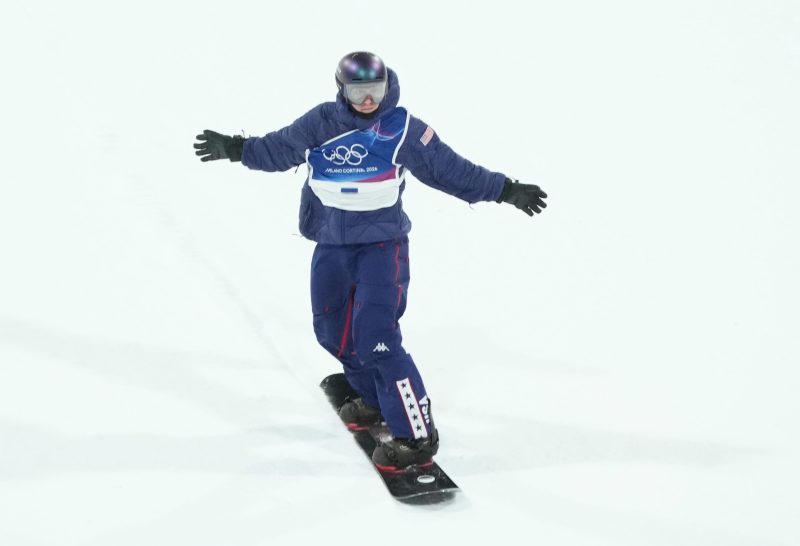
- American snowboarder Red Gerard expressed frustration with being required to compete in big air at the Olympics.
- Gerard and other U.S. snowboarders prefer slopestyle, which they feel has more ‘flow’ and creativity.
- Gerard suggested that big air and slopestyle should have separate qualification paths and teams.
LIVIGNO, Italy – At least Red Gerard was honest.
Asked if he liked competing in big air, the American snowboarder came clean.
“No,” Gerard said Thursday after the big air qualifying, the first competition at Livigno Snow Park during the 2026 Milano Cortina Winter Olympics. “I’m not a fan of big air at all.”
Easy to say after Gerard and two of his teammates were not among the 12 to advance to Saturday’s men’s big air – in which judges rate one trick off a 16.4-foot jump – finals. Ollie Martin, 17, will be the United States’ lone representative.
Gerard, the 2018 gold medal winner in men’s slopestyle, has a legitimate gripe. Olympic snowboarders automatically qualify for both big air and slopestyle competitions once they make their respective delegation’s roster in either event. The issue for the U.S. men’s snowboard big air/slopestyle team is that, well, the majority significantly prefer slopestyle.
“Honestly, I don’t understand why we’re forced to do this,” said Gerard, who finished 20th out of 30 riders. “I don’t like to do this. It’s not what I enjoy doing. There’s no flow to it. It’s a little frustrating.’
Simply, Gerard wants to be more focused on slopestyle, an event he believes has more “flavor” to it.
The three-time Olympian said a part of him feels more pressure and wants to do better in slopestyle, in which competitors go down a course with multiple jumps and chances to ride the rails. Big air is not why Gerard is passionate about snowboarding.
“I love putting together slopestyle runs, making it as unique as I can,” he said. “That gives me the ‘heeby jeeby’ feeling in my stomach when you land a slopestyle run. Big air doesn’t quite do that for me. I just think it’s more of a show than a lot of other things.”
The halfpipe teams in both snowboarding and free skiing are selected separately from slopestyle and big air. The reason is that big air is a blown-up version of one element of slopestyle, the jumps. For example, the big air jump at the X Games is usually the last jump of the slopestyle course. Meanwhile, halfpipe is considered a different skill set.
Gerard realized it’s easy for him to deride an event that is not his best or his preference. That doesn’t diminish his respect for his fellow competitors.
“They’re amazing,” he said of big air specialists. “Very talented. Just not for me.”
Sean FitzSimons, who finished 25th in big air qualifying, said slopestyle was always his focus.
“Big air, it’s fun to do it. It’s not really my event, I would say,” he told USA TODAY Sports. “It was fun to ride (Thursday). But yeah, it’s kind of always been about slope for me.”
FitzSimons said he “could be down” with the separation of big air and slopestyle teams. He understands the big tricks from the jumps in slopestyle naturally translates to big air.
“But for me, I’m a slopestyle rider,” FitzSimons said. “Big airs I do because it’s there. In the future, I wonder if they will go to different teams for that. For now, I just like riding slope, really.”
Gerard said he has never received an explanation for why the big air and slopestyle events are lumped into one team.
“It’s always just been out of our control,” he said. “Maybe they will look at it differently.”
He thinks there is a simple and logical fix.
“If big air, if this is what they like to do,” Gerard said, “they should just be able to go do that.”
Gerard added having another chance to medal means something and it would be “sweet” to bring home two from one Olympics.
“But then again, if I wasn’t forced to do this,” he said, “I wouldn’t do it.”