
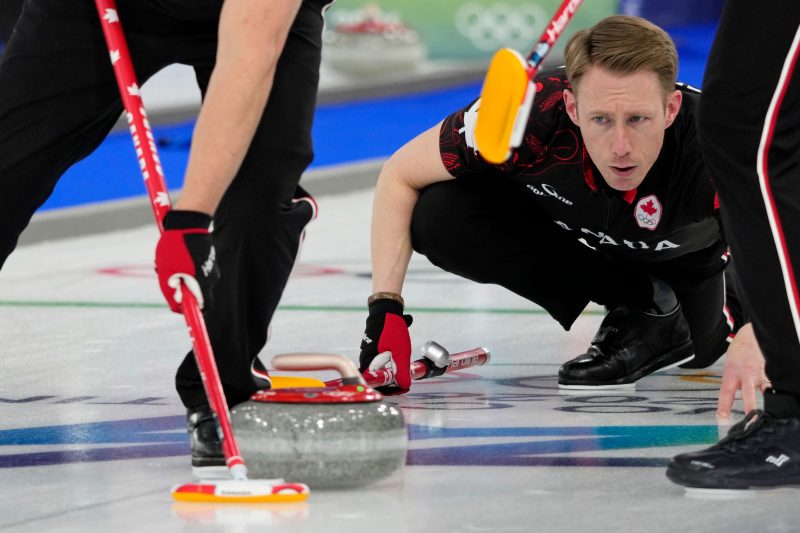
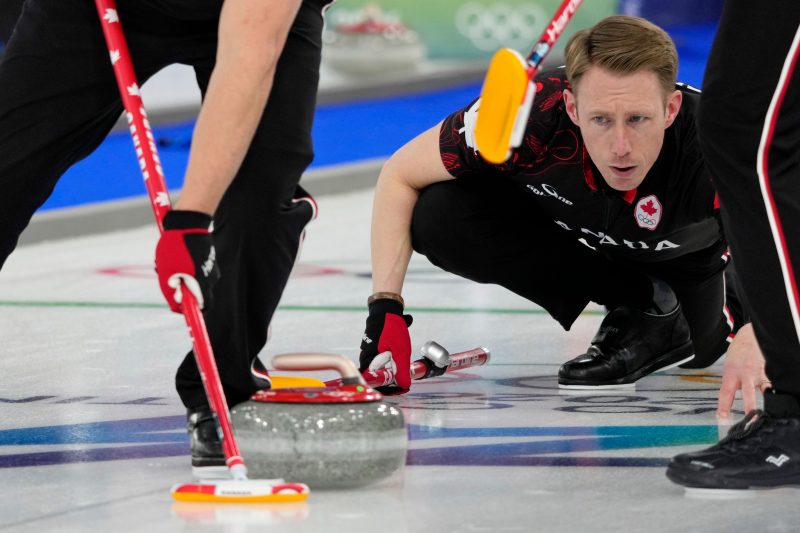
MILAN — Cheating allegations have rocked the men’s curling competition after Sweden accused Canada of intentionally breaking the rules in the Canadians’ 8-6 preliminary round win at the 2026 Winter Olympics.
Sweden’s Team Niklas Edin accused Canada’s Team Brad Jacobs of double touching the stone during their preliminary round matchup at the Cortina Curling Olympic Stadium on Friday, Feb. 13. Tensions boiled over between the squads and a NSFW exchange ensued, resulting in a verbal warning from World Curling.
Kennedy initially asked who before responding, ‘I haven’t done it once. You can (expletive) off.’ Eriksson said he’ll show Kennedy ‘a video after the game,’ which Kennedy replied, ‘I don’t give a (expletive).’
The heated exchange started when Swedish third Oskar Eriksson told Canadian third Marc Kennedy, an Olympic gold-medalist at the 2010 Vancouver Games, ‘Apparently, it’s OK touching the rock after the hog line.’
In response to the accusations, World Curling said officials would monitor opponents’ deliveries more closely moving forward.
‘It is not possible for World Curling to have game umpires positioned to observe all hog lines for every stone delivery,’ the organization said in a statement on Saturday. ‘However, beginning with the Saturday (Feb. 14) afternoon session, two officials will move between all four sheets and observe deliveries.’
But the double touch controversy continued on Saturday when the Canadian women’s team was called for the same infraction the men were accused of. Canada’s Rachel Homan was called for a rules violation for touching the rock in the team’s narrow 8-7 loss to Switzerland. Her first stone was removed as a result, which Homan immediately contested. ‘I’ve never done it in my life,’ the Canadian skip told officials.
‘Yeah it’s frustrating, the officials getting into the game that they have no business getting into,’ Homan told CBC Olympics following the loss. “They said I touched the stone after I let it go, which is so far from the truth, it’s crazy … Just making something up, I don’t know. We have the Maple Leaf on our back, I’m not sure.”
World Curling released another statement on Sunday, Feb. 15, about positioning of umpires: ‘Two umpires who had previously been actively monitoring athlete deliveries remain available in the field of play, but will now only monitor athlete deliveries at the request of the competing teams.’
Here’s everything we know about the men’s curling cheating allegations:
How does Olympic curling work?
Two teams of four people each take turns gliding 44-pound stones down a sheet of ice toward a target that looks like a bullseye. Each match features six to 10 rounds, called ends. The stones have a handle on them, so when they are released, they curl down the ice. As the stone glides toward the target, players sweep the ice in front of it, which can affect the direction and the speed of the stone.
During each round, teams take turns throwing eight rocks, and the team with the rock or rocks closest to the center of the target wins the end. Players can throw guards to block the target, draws to try to score or takeouts to remove the opponent’s stones as each end plays out. There are three curling events in the 2026 Winter Olympics: Men’s curling, women’s curling and mixed doubles.
What happened with Sweden vs. Canada men’s curling?
Team Sweden alerted officials of their opponents’ potential delivery issues during Friday’s matchup, resulting in game umpires being positioned to observe Canada for release infractions for three ends.
‘During this period of observation in the Friday evening game, there were no violations recorded,’ World Curling said in statement on Saturday.
Sweden’s Eriksson alleged that the Swedish team has video evidence of the delivery issues, but World Curling said video replays cannot be used ‘to re-umpire game decisions. Decisions made during a game are final.’
What happened with Canada vs. Switzerland women’s curling?
Canada skipper Rachel Homan’s first stone was removed from the ice by officials for a double touch violation while facing off against Switzerland on Saturday, less than 24 hours after the drama unfolded in the Canadian men’s matchup against Sweden on Friday. An umpire placed on the hog line determined Homan touched the stone again after release. The Canadian team argued the call with chief umpire Brett Waldroff and requested video replay, which isn’t available in curling.
‘Absolutely not,’ Homan said of the violation, adding there’s a ‘zero percent chance’ she double-touched.
Even after Canadian second Emma Miskew and lead Sarah Wilkes’ continued protest the call, the stone was eventually removed. After her next throw, Homan told officials, ‘It’s the same throw as my last one. It’s unreal.’
The Canadian women went on to lose the match to drop to 1-3. Homan said the violation got in her head, telling CBC Olympics, ‘Obviously it rattles you and we fought hard and we lost in an extra by one point. It’s just a shame that had to happen.’
Is double touching allowed in curling?
According to the World Curling rulebook, players can retouch the handles before the hog line, ‘a line extending across the width of the sheet that is parallel to each tee line,’ but touching the handle after the hog line isn’t allowed. A violation would result in the stone being removed from play.
— Rule R.5 (e): “A stone must be clearly released from the hand before it reaches the hog line at the delivery end. If the player fails to do so, the stone is immediately removed from play by the delivering team.”
A player is not allowed to touch the granite of the stone during forward motion. This violation would also result in the stone being removed from play.
— Rule R.5 (d): The curling stone must be delivered using the handle of the stone.
Curling Canada responds
The Canadian men’s team was issued a verbal warning over explicit language used during Friday’s game. According to World Curling, Kennedy’s profanity broke Rule R.19, which states: “Improper conduct, foul or offensive language, equipment abuse, or willful damage on the part of any team member is prohibited. Any violation may result in suspension of the offending person(s) by the curling organization having jurisdiction.”
Curling Canada said its athletes showcased ‘passion’ during the ‘highly competitive’ matchup, but noted that the organization was supportive of the warning.
‘We want to reaffirm that Curling Canada fully supports fair play, respect and sportsmanship, values that are fundamental to our sport,’ the statement reads. ‘We appreciate the support and enthusiasm of curling fans everywhere, and we look forward to continuing to cheer on and support our Canadian teams in Cortina on their journey.’
The USA TODAY app gets you to the heart of the news — fast. Download for award-winning coverage, crosswords, audio storytelling, the eNewspaper and more.