
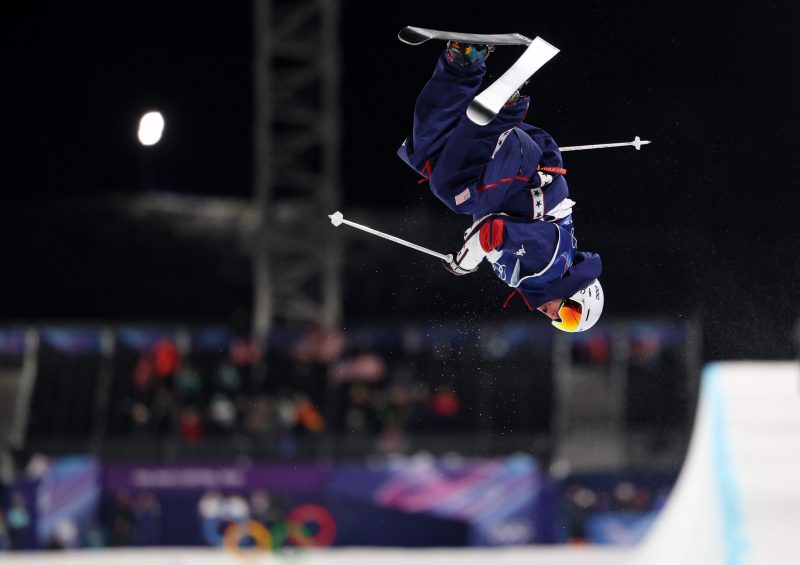
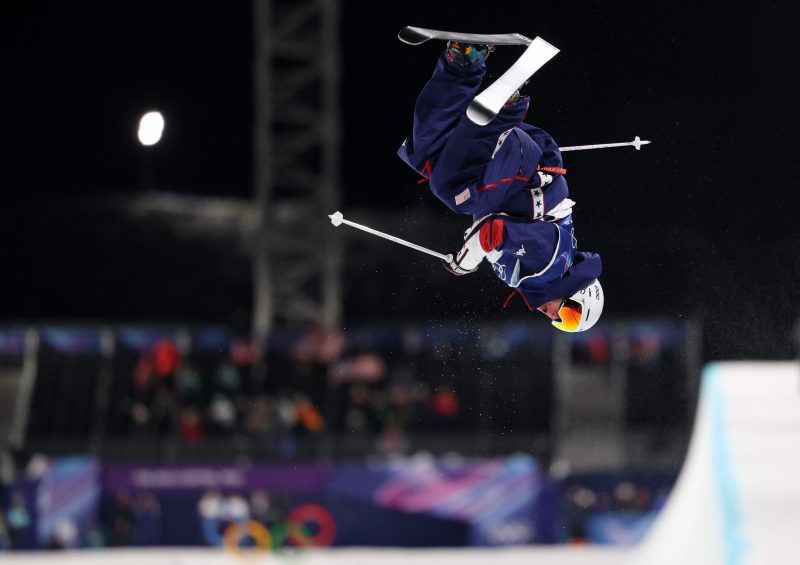
LIVIGNO, Italy – Alex Ferreira stood at the top of the halfpipe and repeated the incantation he’d come to rely upon.
I am greatness.
This is my moment.
And I can feel it in my bone marrow.
Five tremendous jumps above the 22-foot-walls later, Ferreira had achieved greatness. Indeed, it was his moment. And now, down to his bone marrow, he is an Olympic gold medalist.
Ferreira, 31, won the men’s free ski halfpipe competition with an electrifying third run to add to his medal total, which included a silver (2018 PyeongChang) and bronze (2022 Beijing). All that was missing was gold, and he entered the 2026 Winter Games determined to “complete the set,” he said.
In October, he told USA TODAY Sports he keeps his medals above his bed to remind himself that hard work enables success. Gold will be quite the addition to the collection.
‘It’s way different,’ Ferreira said. ‘There’s nothing like gold.
“It’s a hundred times better than I ever thought it would be. It’s the most beautiful moment I’ve ever experienced in my life. I’m so insanely grateful.”
It goes to show, Ferreira said, to never stop believing in yourself. Ferreira’s sister, Lourdes, said this performance was a “thank you” to those who supported him throughout his career.
“And just (expletive) go for it,” said Lourdes, who is eight years Alex’s junior, “this is what he was here for, to say it very kindly.”
Because of the clarity her brother possessed entering the competition, which had the quirk of qualifying in the morning and finals at night because of bad weather affecting the schedule here, was the least nervous he’s ever been before an Olympic final.
That’s good, Ferreira said, because prior to that moment, it was the worst day of his life. He awoke with a pounding headache and took Tylenol.
‘You never know what the end of a day can bring,’ he said.
Ferreira wasn’t pleased that qualifying and finals were in the same day, but there was going to be a competition no matter what, so he might as well leave it all out there.
“It’s (indescribable), because we’ve been working very hard for the last three Olympics,” a hoarse and breathless Marcello Ferreira, Alex’s father and a former professional soccer player from Argentina, said. “So now he has the full cycle.”
Like many of the 12 skiers during the first run of finals, Ferreira struggled. He ended the round in third, but with a low score. Ferreira showed why he was the favorite coming into this contest with a 90.50 on the second run. Estonia’s Henry Sildaru threw up a 92.75 after that to push him down to second heading into the final run.
Ferreira steeled himself and dropped in. He went switch-right double-cork 1080 Japan, “pretty big,” he said, leftside double-cork 1620 safety, rightside double chuck, 1080 Japan, switch leftside Japan and finished with a rightside double 1620 safety. He knew it was the run he’d spent his entire life building toward and celebrated with his patented “pole lasso” move.
The score came in: 93.50. The contingent of Ferreira supporters in the first row at Livigno Snow Park combusted. Screams. Tears. Hugs.
Ferreira is even more interesting outside of skiing, a beautiful person, she said.
“He’s smart. He’s kind. He’s funny. But most of all, he’s driven,” said his girlfriend, Deirdre Heggerty. “And he did it really beautifully today.”
Then the “living nightmare” of waiting began, with three competitors to go.
“I hated every second of it,” he said.
Ferreira could hardly watch and bit his knuckle as Sildaru’s final score was posted — 93 flat.
Earlier, his friend and teammate Nick Goepper, at the time in third, suffered a brutal crash on his final jump of a run that might have secured a medal in his Olympic halfpipe debut.
Canada’s Brendan Mackay, the final competitor and top qualifier, had a tremendous final run and ultimately finished with the bronze medal. Ferreira thought the golden dream was dead. But the judges didn’t agree, and when Mackay’s score went up on the board, 91, the celebration for the Ferreira clan was officially on.
The other podiums he’s earned throughout his career, the X Games wins and other accolades, are validating, but the Olympic gold medal solidifies a career, Ferreira said.
“And I don’t just say that about myself,” he said before rattling off a list of other greats, such as David Wise, who won the first two halfpipe free ski golds in 2014 and 2018.
‘It’s just, I guess, the extra, last little tick,” Ferreira added.
Both arms raised, Ferreira took that lunge to the top step of the podium with pride, shook fellow medalists’ hands, threw arms up in the air again, then put his hands on his head in disbelief. He hugged the International Olympic Committee who gave him the gold he desperately desired. His group of friends started singing the “Star Spangled Banner” halfway through the instrumental playing.
About three years ago, Ferreira completely rededicated himself to training and cut out the partying.
“Just sheer hard work and consistency,” Ferreira said. “Just absolutely going for it every single day. Our sport is really scary and you have to push yourself out of your comfort zone.”
For a long time, people didn’t consider Ferreira a champion. He felt overlooked. He made it personal.
Nobody treated him like a professional. So he started treating himself that way. The respect followed.
“Now I’m an Olympic gold-medalist,” said the kid who grew up in Aspen, Colorado and would sneak out of school with friends to watch the world’s best freestyle skiers practice.
Ferreira won all seven of his competitions that season (2023-24). His mom — not meaning it nefariously — said something along the lines of how convenient it’d be if the Olympics were that year.
“I was thinking I definitely peaked too early,” Ferreira said.
He also felt the pressure from Marcello, who “basically, he says all the time, you have to win the gold medal.”
“This is the most beautiful closing of a career,” Marcello said, “of a real champion.”
Ferreira doesn’t know if this is actually it, though, and wouldn’t commit one way or another to whether this was the end of the line.
‘It’s gonna be hard not to compete with these guys,” he said gesturing to the medalists on either side at the dais. ‘It’s been my life for the past 20 years. So, I would like to.”
Ferreira admitted to suffering from post-Olympic blues but has set his life up differently — he’s in control of himself now, he said, and thinks it will be the best time of his life.
And if it is indeed the end for Ferreira, what a way to go out.
USA TODAY Sports reporter Gentry Estes contributed to this report.